Conversational latency
Calls that feel like being in the room. Median glass-to-glass latency in the mid-50s of milliseconds, measured end to end: camera, network, screen.
Work · Flagship 00000000
Media Over QUIC Orchestration Mesh. Real-time video that does the job of a video call and the job of a live broadcast, on one open standard, with sub-60 ms glass-to-glass latency.
The category
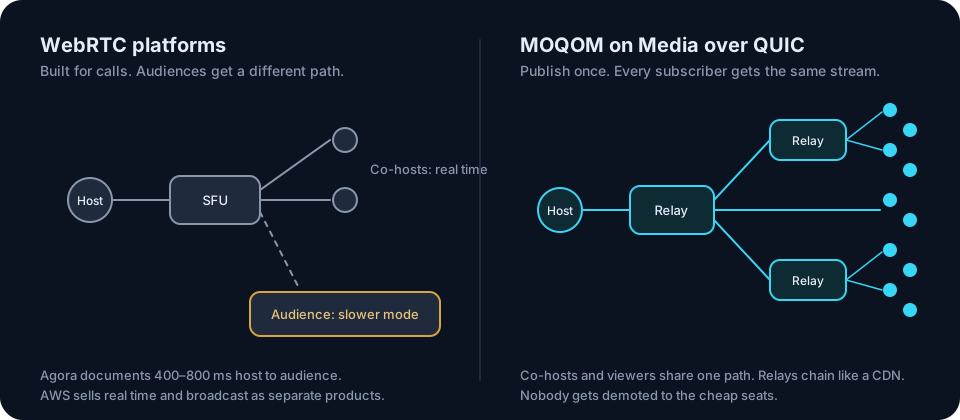
One half is fast and small: video calls that feel live but strain past a room’s worth of people. The other is big and slow: broadcast that reaches everyone, seconds behind. Every product picks a half and iterates on it.
Media over QUIC is the IETF’s answer to that split, a standard designed for both. MOQOM is our bet that the category it creates deserves a platform built for it from the first line, rather than retrofitted onto either half.
It began as a way to test MLVC, Microsoft’s learned video codec. Development started the same day Microsoft released it, in July 2026. MLVC’s encoder and decoder aren’t fully ready yet, so MOQOM runs on the device’s hardware codecs, H.264 and HEVC. Of those, HEVC was the fastest in our tests.
Outcomes
Calls that feel like being in the room. Median glass-to-glass latency in the mid-50s of milliseconds, measured end to end: camera, network, screen.
The same stream that carries a two-person call carries an audience of thousands, from a single modest relay, without dropping anyone.
An independent implementation of the IETF’s Media over QUIC Transport, speaking drafts 22 and 19 of draft-ietf-moq-transport, over QUIC and WebTransport.
Built for mobile networks that drop, switch and congest. Calls survive a move from Wi-Fi to cellular, video steps down before it stalls, and the SDKs reconnect and restore the room on their own.
Every relay keeps the last seconds of every stream. Late joiners see a picture instantly, viewers who drop come back to a full screen, and anyone can replay the moment they missed.
Run relays on MOQOM Cloud or on your own servers, anywhere. Relays shard across cores, scale out and chain to other relays like a CDN.
Security
End-to-end encryption isn’t a setting in MOQOM. It is how every room works, post-quantum from the first key, and 1:1 calls skip the relay entirely.
Every room, every call, every broadcast. There is no switch to turn it off. Media is encrypted per frame on the sender’s device with AES-256-GCM and opened only on the receiver’s, so relays forward ciphertext they can’t read. 54 µs per 1080p keyframe, against a 33 ms frame budget.
Room keys are agreed over ML-KEM-1024, and group membership, join tokens and device proofs are signed with ML-DSA-87, the NIST standards. Recording traffic now to decrypt it later with a quantum computer doesn’t work, and AES-256 media keys already hold up against quantum attack.
1:1 calls and small private rooms connect device to device over QUIC, so the media never touches a server, ours included. Still end-to-end encrypted, still post-quantum. Prefer not to share your IP address with the other side? Choose relay-only for that call.
Every join token is bound to an ML-DSA-87 key held in the device’s Secure Enclave, and every connection proves it holds that key with a single-use proof tied to the server’s certificate. Stricter than DPoP: a token lifted from logs or memory works nowhere else.
Phones pin the relays’ certificates, so a forged certificate from a hijacked domain gets nowhere. Our domains carry CAA records and DNSSEC, and certificate transparency logs are watched for any certificate we didn’t issue.
The cryptography is public: moqom-token, moqom-proof, moqom-sframe and moqom-mls, in Swift, Go and Rust, under Apache-2.0, with shared test vectors every language must pass.
By resolution
Co-host sizes matter most: shared video calls use smaller boxes, so each person publishes at 360p–540p.
| Resolution | Typical use | Median |
|---|---|---|
| 4K (2160p30) | Solo host, broadcast | Results soon |
| 1080p30 | Host / spotlight | Results soon |
| 720p30, 1.25 Mbit/s | Two-person call | 56–57 ms (p95 70 ms)* |
| 540p60, 600 kbps | Co-hosting (publishing and decoding the other host) | 69 ms* |
| 360p30 | Co-host tiles in shared calls | Results soon |
| Shared video calls | Group calls, 360p–540p per tile | Results soon |
Why MOQOM
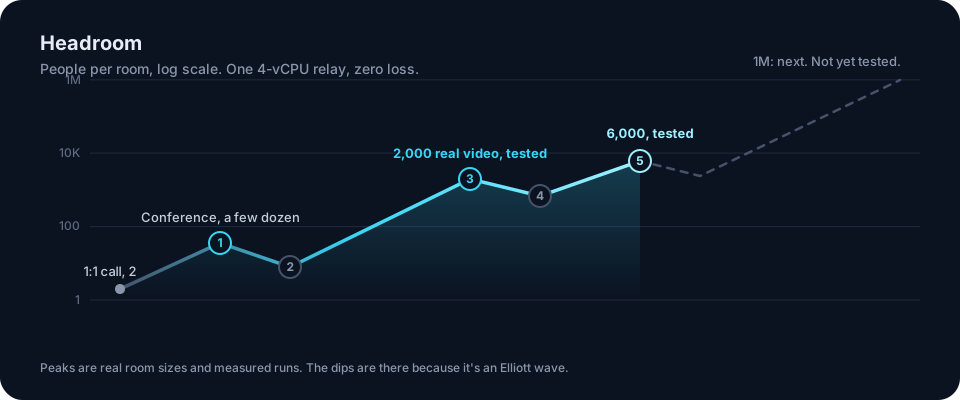
* Built to scale: a Rust media plane and a Go control plane, each scaling out horizontally. Measured in lab: 6,000 viewers on one 4-vCPU relay, every frame delivered. Full data at moqom.cloud/benchmarks/load-tests.md.
Sourced comparison with Agora, Tencent RTC, Google Cloud, AWS and Cloudflare →
Platforms
Client SDKs for every screen, and server-side SDKs in Go and Rust for the backends that run rooms.
| Platform | Status |
|---|---|
| iOS | Available |
| macOS | Available |
| Web | In progress, coming Q4 2026 |
| Android | In progress, coming Q4 2026 |
| Desktop | In progress, coming Q4 2026 |
| OBS plugin | Scoped, work ongoing |
The studio’s role
Elliott Wave LLC created MOQOM and owns all of its intellectual property, the open-source SDKs included. Patents pending. The SDKs and security libraries developers build on are open source; the engine that makes MOQOM fast, from the relays to the player, is licensed.
Partnerships
We plan to partner with Cloudflare, Google Cloud, AWS and other CDNs and content providers. We don’t wait to ship: MOQOM runs on Google Cloud today, and customers can self-host relays anywhere. No partnership is signed yet.
MOQOM already works with Cloudflare’s MoQ relays: point the SDK at them and media flows across Cloudflare’s network, still end-to-end encrypted. Cloudflare runs draft-16 of the standard, published in January 2026, while moqom.cloud and self-hosted relays run draft-22 from October 2026, with the features that came after. We’ve proposed improvements to the IETF MoQ specification for wider adoption. Until they land and others catch up, MOQOM is the first and only platform with all of its patent-pending technology shipped.MOQOM on Cloudflare →
A macOS menu bar app that gives every app the same ⌘ chords. You choose the menu item each chord clicks in each app, and on-device AI helps a chord mean the same thing in apps where you haven’t set it yet, without anything leaving your Mac. Playing chords earns aura, which unlocks more chord keys.
Ripples in spacetime.
Your idle Mac can help find ripples in spacetime. While it is idle and plugged in, six10nine lends spare CPU and GPU time to Einstein@home, the Max Planck Institute for Gravitational Physics’ volunteer search for new pulsars and the first continuous gravitational waves. It is on by default in setup and off with one click from the menu bar. einsteinathome.org ↗
Free and source-available under the PolyForm Noncommercial License 1.0.0: free to use and modify for noncommercial purposes. It is not OSI open source, and it can’t be sold. Patents pending.
A signed DMG and a Homebrew cask are coming, release planned October 2026, plus an MCP server for AI assistants.
github.com/elliott-wave-labs/six10nine · Repository goes public soon
Work · Project 03
iOS · Featured by Apple
Group photos where everyone looks their best, in one tap. Unify picks the best real moments from your Live Photos and combines them, so nobody is caught blinking or mid-frown. Nothing is morphed or generated: every face is really you.
Elliott built Unify for himself and released it in late 2019, thinking others might like it too. Apple featured it on the App Store before it had subscriptions, because it improves on Apple’s own Vision framework with custom technology of ours, with more still unreleased. Then COVID arrived, and promoting an app for group photos didn’t feel right. So it waited.
Now Unify is moving into elliottwave.studio lab, to be updated and properly promoted. Free to try on the App Store, and still unmatched at one-tap group photos.
Work · Project 04
Coming this month or this quarter · Q4 2026
Real places, whole. Walk in.
Kalopsia captures entire real spaces, room to room, so you can explore them as they are rather than scroll past them. There is no feed to swipe. You walk through a space, look around, and teleport to the next one.
Explore in VR, AR, visionOS, on mobile and on the web.
Kalopsia has been in the making in the lab since 2015, long before the tools caught up with the idea. Now it can be done properly: whole spaces, captured for the Kalopsia platform.
Work · Project 05
Coming this month or this quarter · Q4 2026
Ticketing for live and digital events, without fee gouging.
Ticketing has been iterated on for decades and still frustrates the people on both sides of the ticket. We didn’t add another feature to the old model. We started over, the way the lab approaches every category.
The name and how it works stay private until launch. It changes the game, and we’d rather show you than tell you.
Contribute
The SDKs and six10nine are open on GitHub. Fix a bug, improve the docs or port to a new platform.
Pick an issue in moqom-go, moqom-rust, moqom-swift or six10nine and open a pull request. Contributors sign the Copyright Assignment Agreement linked from each repository.
Merged contributions are credited in the release notes, and we send a reward: swag in the mail or a tip to your crypto wallet.
As the lab grows, we look first to the people already contributing. Regular contributors may be offered paid contract work.
Our bug bounty runs on HackerOne, launching as a vulnerability disclosure program. Cash bounties are funded by donations to the open-source projects until paying customers adopt MOQOM. Every valid report gets public credit.
Nothing to show yet, by design. We announce work when it is ready to define its category.